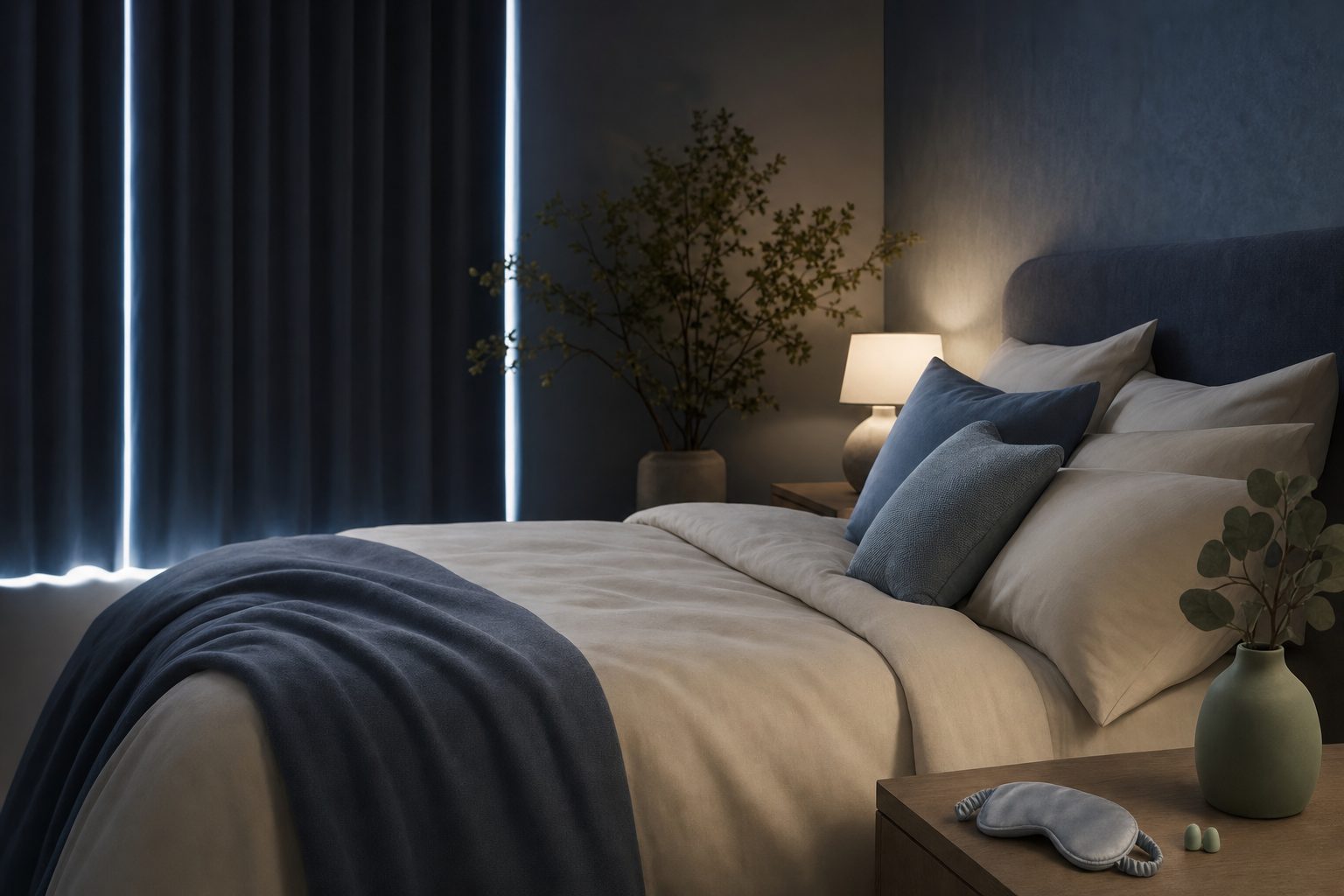
How do you set up a dark, quiet bedroom for better sleep during a benzo taper?
To set up a dark, quiet bedroom for better sleep during a benzodiazepine taper, lower the sensory load the room places on an over-activated nervous system: block outside light and cover the small glowing lights of electronics, soften or mask sudden sounds, and keep the room cool, uncluttered, and low in stimulation.
Withdrawal often heightens sensitivity to light and sound. A controlled, predictable room gives the body fewer things to react to, and that can make rest easier to reach, even on nights when normal sleep does not come.
A better room is a helpful lever, not a cure. If insomnia stays severe, that is a reason to talk with your prescriber about the pace of the taper, never a reason to change a dose on your own.
Why start with the bedroom at all? Because it is one of the few sleep factors a person in a taper fully controls. The biology of withdrawal insomnia cannot be rearranged tonight. The room can, cheaply, without asking anyone’s permission.
One honest note before the practical steps: there is no benzodiazepine-specific research on bedroom setup. These suggestions rest on clinical experience and on what patients in withdrawal consistently report, and individual response varies.
Why do light and sound feel louder in benzo withdrawal?
Patients often describe an ordinary room turning hostile. A streetlight through the blinds feels like an interrogation lamp. A ticking clock, a refrigerator hum, or a partner turning over in bed feels impossible to ignore, and the body stays braced as if on guard duty.
This is not imagination, and it is not simply the old anxiety coming back.
Heightened sound sensitivity (hyperacusis) and light sensitivity (photophobia) are part of the sensory overload some people experience with benzodiazepine-induced neurological dysfunction (BIND), the constellation of neurological symptoms that can accompany tapering and withdrawal.
The short version of the mechanism: benzodiazepines act on the system run by gamma-aminobutyric acid (GABA), the brain’s main calming neurotransmitter. Long-term use leaves that calming system temporarily underpowered as the dose comes down, so the stress response runs hot, and the senses run hot with it.
The takeaway for the bedroom is simple. The reaction is real and physiological, which is exactly why controlling the environment helps. Fewer triggers reaching a sensitized nervous system means less for that system to fight.
How do you make the bedroom dark?
Darkness is the first project, and the cheapest.
- Block outside light at the window. Blackout window coverings are the standard tool. Heavy blankets or layered curtains work fine while you decide.
- Keep an eye mask as a fallback. It covers the gaps every curtain leaves, and it travels.
- Hunt down the small glowing lights. Chargers, power strips, televisions, and standby indicators all glow, and a sensitized eye finds every one of them. Cover them with tape or unplug what you can.
- Dim the evening. In the last hours before bed, favor low, warm lamplight over bright overhead light.
- Keep screens out of the final stretch. The light is part of the problem; the stimulation is the rest of it.
No specific product matters here, and no brand is worth chasing. Categories do the work: something over the window, something over the eyes, something over the little lights.
How do you make the bedroom quiet?
Quiet is a harder project than dark, because the goal is not silence.
In hyperacusis, a silent room punctuated by sudden bangs is often harder to tolerate than a room with a constant gentle sound. The startle is the enemy, not the noise itself.
- Add a steady low background sound. A fan or a white noise source masks the doors, pipes, and traffic that jolt a braced body.
- Try soft foam earplugs, alone or underneath the background sound.
- Let soft furnishings absorb sound. Rugs, curtains, and upholstered pieces take the sharp edges off household noise.
- Silence the phone. Set it to do not disturb, and charge it out of arm’s reach if you can.
- Make a household plan. Ask the people you live with to move loud chores away from your wind-down hours. Most people help gladly once they understand why it matters.
What about temperature, clutter, and scent?
A cooler room generally favors sleep. Withdrawal complicates the picture, because temperature dysregulation (running hot and cold for no environmental reason) is a common withdrawal symptom. So comfort is individual: adjust toward whatever feels calming rather than chasing a fixed number.
Choose breathable bedding and keep some air moving. Layers beat one heavy cover, because layers can be adjusted at 3 a.m. without turning the bed into a project.
Clear the visual clutter. A pile of laundry or a desk of unfinished tasks is one more thing for a vigilant brain to scan. A plain, orderly room gives the eyes nowhere alarming to land.
Be cautious with strong scents. Chemical and scent sensitivities are common in withdrawal, and an air freshener that once seemed pleasant can become a trigger. Unscented is the safe default.
How does a simple routine make the room work better?
A dark, quiet room works best when it is predictable.
Consistency calms the stress system. The same wind-down steps, the same dimming of the lights, the same bedtime, night after night, teach a destabilized nervous system that this room and this hour are safe.
Keep the bed associated with rest. Reading, working, and worrying are better done somewhere else, so that lying down carries one meaning only.
And hold the goal loosely. On hard nights, the room’s job is not to force sleep but to make rest possible. Lying still in the dark, warm and unstartled, is not failure. It is the lightest load your nervous system will carry anywhere in the house.
What if a better room is not enough?
Sometimes it is not, and that should be said plainly.
There is also a taper-pace conversation worth having. If nights stay hard week after week even in a good room, that pattern is information for your prescriber, not a verdict on your effort. A gradual taper that reduces by smaller proportional steps as the dose gets lower, the approach described in the Ashton Manual and the Maudsley Deprescribing Guidelines, tends to keep sleep disruption more manageable than fixed or hurried cuts. Adjusting the pace is always a prescriber decision, never a change to make on your own.
Withdrawal insomnia is driven by a destabilized nervous system, not by the bedroom. The environment lowers the number of triggers; it does not repair the cause. No one should feel they failed at sleep hygiene when the real problem is neurological.
Persistent, severe sleeplessness during a taper is information. In Dr. Leeds’ experience, it usually means the reductions are moving faster than the nervous system can adjust, and the right response is a conversation with the prescriber about slowing down or holding the current dose. Holding is protective, not weakness.
It is never a reason to stop the medication abruptly or to change the dose alone. Abrupt cessation is dangerous and can cause seizures. And it is worth repeating in a culture that keeps getting this wrong: physical dependence is not addiction. Needing a slower taper is a fact about GABA receptors, not a character flaw.
Call 911 or seek emergency care if you have a seizure, chest pain, trouble breathing, severe confusion, or hallucinations, or if days of little or no sleep have left you feeling unsafe.
If you have thoughts of suicide or self-harm, call or text 988, the Suicide & Crisis Lifeline, at any hour. Do not wait for morning.
Emergency care is never the wrong call in a crisis, and no prescriber worth keeping will fault you for making it.
Does sleep improve as the nervous system stabilizes?
For most patients, yes, though rarely in a straight line.
Recovery tends to arrive in windows and waves: stretches where sleep comes easier and the senses soften, followed by stretches where symptoms return. Over time, the windows lengthen and the waves lose force. A better night is real progress even when the next night is hard again.
Even for patients whose symptoms persist into protracted withdrawal, sensory sensitivity tends to ease as the nervous system recalibrates. The nervous system is not broken. It is adapting to the loss of a chemical it was made to depend on, and regulatory systems can recalibrate with time, safety, and proper medical support.
One night, further along, the streetlight will be just a streetlight again, and the refrigerator hum will be nothing at all.
That patience is the same principle behind a well-run taper. Mark Leeds, D.O. is an osteopathic physician and deprescribing specialist in Fort Lauderdale who serves on the medical advisory board of the Benzodiazepine Information Coalition. In his practice, the pace of a taper follows the patient’s nervous system rather than a calendar, and levers like the bedroom are treated as part of care, not an afterthought.
Dr. Leeds sees patients by telemedicine throughout Florida, with weekly appointments and direct physician care at every visit. Readers outside Florida are welcome to use this article as education. Floridians who cannot sleep through their taper can contact Dr. Leeds to talk about a slower, more individualized plan, or read more about working with a benzodiazepine tapering doctor.
What else do patients ask about the bedroom during a benzo taper?
How do you set up a dark, quiet bedroom for better sleep during a benzo taper?
Block outside light with blackout window coverings or an eye mask, cover the small standby lights on electronics, mask sudden noises with a fan or white noise, and keep the room cool, uncluttered, and free of strong scents. Treat the room as a helpful lever, not a cure.
Why do light and noise bother me so much more during benzo withdrawal?
Heightened sound sensitivity (hyperacusis) and light sensitivity (photophobia) are part of the sensory overload some people experience during withdrawal and BIND. The reaction is physiological and real, and it tends to ease as the nervous system stabilizes.
What is the best room temperature for sleep during a taper?
Cooler generally helps, but withdrawal can disturb temperature regulation, so comfort is individual. Adjust toward what feels calming rather than chasing a fixed number.
Do blackout curtains or a white noise machine really help?
They can reduce the light and sound triggers a sensitized nervous system reacts to. Evidence specific to withdrawal is limited; the support comes from clinical experience, and response varies. No particular brand is needed or endorsed.
Will a better bedroom fix my benzo withdrawal insomnia?
No. A good room lowers triggers, but the insomnia is driven by a destabilized nervous system. Persistent, severe insomnia is worth raising with your prescriber, who may consider slowing or holding the taper.
When should I be worried about not sleeping?
Days of near-total insomnia, confusion, hallucinations, or any thoughts of self-harm warrant urgent help: call or text 988, or call 911 or seek emergency care, and then talk with your prescriber. Do not change your dose on your own.
This article is educational only. It is not medical advice, and reading it does not create a doctor-patient relationship. Decisions about a benzodiazepine taper belong with the patient and the prescribing physician.