updated on January 30th, 2023.
Is the Suboxone film manufacturer gaslighting patients and doctors? They make limited dosages and then tell doctors to instruct their patients to not split the films. How can patients taper at the end of treatment? We would rather that patients did not have to split their strips. Why don’t they make tapering strips?
What is the best way to split a Suboxone strip?
A buprenorphine/naloxone sublingual film can be cut in half with your fingers if you are careful. Some people will fold the strip in half and then carefully tear it along the crease.
I have personally known many people who have used this simple hand-tearing method to split a film into two pieces. They often use the foil that the strip came in to store the remaining half for later use.
While hand-tearing may work to split an 8mg film into two 4mg pieces, or to split a 2mg film into two 1mg pieces, the process will not be as accurate for cutting into smaller pieces. If you are trying to split the film into three equal pieces, four equal pieces, or even eight pieces, it will take additional tools for more precision.
In most cases, a patient in their first months of treatment will not need to worry about splitting Suboxone strips. However, later in treatment, cutting down on buprenorphine may require splitting films or tablets to reduce the dosage gradually in order to taper more smoothly.
Use a ruler for accuracy.
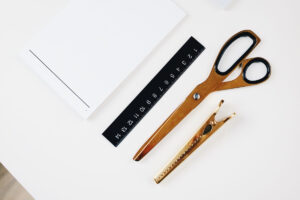
A ruler with millimeter markings will help to make accurate measurements of the film. We cannot give precise measurements here, because there are a variety of generic Suboxone films available that are sized differently.
Someone recently shared a story with me about how he was ready to discontinue Suboxone, so he used this method to taper gradually off of buprenorphine/naloxone strips. He measured and tracked the process carefully, using a razor blade and an accurate ruler to divide the Suboxone films carefully into smaller pieces for tapering.
To make the precise cuts, a razor blade or sharp scissors will work best. When using a razor blade, a person must take utmost care to avoid injuries.
Handling the strips with wet or damp fingers will lead to destruction of the medicated film, so it is important to work in a dry area. Also, tweezers may be best for handling individual pieces.
Pieces of the film that are not used may be stored in aluminum foil, and then the foil can be placed in a Ziploc bag. Keeping the cut segments of Suboxone sublingual film is essential to maintain potency.
Use a pill splitter for cutting tablets.
Many pill splitters, such as the type you can buy in nearly any pharmacy, have a mechanism to prevent pieces of tablets from flying across the room. If you hand-split the tablet or use any other method, you may want to use a large Ziploc bag, such as a one-gallon or 2.5-gallon bag as a work area.
By placing your hands and tablet splitting tools within the bag, pieces will not be able to fly to the floor by accident. Losing pieces of the tablet will result in loss of some of your medication and also the risk that a pet or child may find the medicated pieces, so this must be avoided.
Consider compounding as an alternative.
If your doctor recommends that you split Suboxone films, tablets, or ZubSolv or Subutex tablets to achieve a smaller dose for tapering, let them know if you are not comfortable with the process. You can ask about compound pharmacies that may be willing to create a customized dosage for you.
Compound pharmacies can make dissolving troches that contain buprenorphine and naloxone that are designed to dissolve under the tongue, just like the brand films and tablets. They can make a precise dosage as ordered by your doctor, and they can flavor the medication to suit your taste.
Any changes to how you take your medication must be discussed first with your doctor.
I understand that cutting or splitting Suboxone films or Suboxone tablets, ZubSolv tablets, or any of the many generic Subutex tablets is considered an off-label practice and not recommended by the manufacturers and also not recommended by some of the large treatment facilities that provide Suboxone treatment.
Why are they so concerned about a patient, with guidance from their doctor, splitting a 2 mg strip or pill in half to taper down from 2 mg to 1 mg daily? If there is a problem with splitting or cutting Suboxone, why not provide lower dosages?
In England, Australia, and probably other countries, there are 200 mcg and 400 mcg tablets, sold under the brand, Temgesic. I’ll help out with the math: 200 mcg = 0.2 mg, and 400 mcg = 0.4 mg. Imagine how much more convenient it would be for a patient to taper to lower dosages, with a goal of completing Suboxone therapy?
Even Suboxone experts tell their patients to cut Suboxone films or tablets during the tapering process.
Also, I once went to a lecture at a major medical conference where one of the addiction treatment specialists lecturing mentioned that many patients taper down to 1 mg daily and then have difficulty reducing further or stopping buprenorphine. Now, I am wondering, how did he have them at 1 mg? Was a recognized expert in the field going against manufacturer recommendations, having his patients cut a 2 mg dose in half?
It almost seems as if the intent of Suboxone, ZubSolv, and Subutex manufacturers is to keep patients on treatment indefinitely. While long-term treatment is ideal for some patients, many other patients are ready to reduce and discontinue treatment at some point, after at least a year of treatment.
Why can’t you cut Suboxone films?
The main reason you may want to avoid cutting your prescribed Suboxone strips is that the manufacturer states in the prescribing information that they are not to be cut. They give no further reason for not splitting the strips. It’s as if they are saying, “don’t do it because we said so.”
Why would you want to cut Suboxone films in half?
There are a few reasons why patients do this. Sometimes doctors recommend it. Suboxone has a long half-life, but the main beneficial effects can still wear off throughout the day.
The benefits of Suboxone for patients overcoming opioid addiction is that it blocks cravings and withdrawal symptoms. In order to have better twenty-four hour coverage, doctors sometimes recommend cutting the film in half and taking half a strip in the morning and the other half at night.
Why cut the Suboxone sublingual film in half when you can get it in lower dosages?
Suboxone films are available with 12 mg, 8 mg, 4 mg, and 2 mg of buprenorphine, the main ingredient. Unfortunately, most pharmacies do not routinely carry all strengths of the buprenorphine/naloxone strips. The most common strengths that you will find at pharmacies are the 8 mg and 2 mg films. Many patients request that their doctors do not prescribe the 2 mg films because the cost is nearly the same, even though they are a quarter the strength.
Can you split Suboxone film into two equal pieces and get the same dosage in each half?
While Indivior, maker of Suboxone, and the generic manufacturers of buprenorphine and naloxone films, such as Mylan and Dr. Reddy, do not explain their reasoning, you can find the explanation elsewhere. In the manufacturing of the film, the active ingredients may be evenly distributed throughout the film, but there is no guarantee that it is.
As it turns out, patients report that splitting Suboxone films in two equal pieces does result in two pieces of equal medication strength. However, this could change at any time.
Going against manufacturer recommendations can lead to problems.
The situation reminds me of the concept of an API, or application programming interface. When a programmer decides to write an app for iPhones, Apple provides an extensive set of interfaces and instructions on how programmers are allowed to access built-in functions in iOS, the iPhone operating system.
Sometimes, programmers go off the beaten path and decide to do things their own way. They bypass the API and improperly access system functions that they are not supposed to use. The problem is that Apple is allowed to change anything in the system as long as the API stays consistent for app programmers. A programmer that bypasses the API may find themselves in trouble at any time when an update rolls out.
The situation for Suboxone patients is similar in that because the manufacturer has instructed doctors to let their patients know not to cut the strips, they have no obligation to make the strips work as expected when cut into two or more pieces. Yet, so far, it seems that cutting the Suboxone films in half works well enough.
However, cutting the films into more than two pieces can lead to more questionable results. In fact, there is some discussion about the possibility that the films, when cut into more than two pieces, are more likely to have an uneven distribution of medication. This means that if you were to cut your prescribed Suboxone 8 mg strip into, say, four pieces, expecting each piece to contain 2 mg of buprenorphine, you may find that the results are not as expected.
Can you split Suboxone film into eight pieces?
The length of a Suboxone film is approximately 22 mm. If you were to cut it into eight equal pieces, each piece would be 2.75 mm across. In order to perform this operation, you are going to need some precision cutting and measuring tools.
Most likely, you will find that cutting a film into eight equal pieces is almost impossible. And, remember that each piece may not contain the same amount of medication as the other pieces.
Addictive behavior is one concern in splitting Suboxone films.
Addiction treatment experts have voiced concerns about patients cutting their medication into pieces. They believe that the focus on carefully splitting up a dose, using special paraphernalia is too reminiscent of how you may have used drugs.
One of the great benefits of medication-assisted treatment with buprenorphine is that you can live with a clear mind, without the obsession over using drugs. Yet, when you begin your day with taking out your ruler and razor blade or precision scissors, subconsciously, you may associate this behavior with how you acted when you were using drugs to get high.
Is the issue of reinforcing addictive behavior a problem for all patients?
While this may be an issue for certain patients, it is not necessarily an issue for all patients. It would be unfair to treat all patients in the same way. It is possible that some patients can cut their Suboxone film without any psychological issues.
We must always keep in mind that our patients are individuals with unique issues relating to past drug use. There is no one-size-fits-all treatment plan that applies equally well to all patients.
What would be the advantage of cutting an 8 mg Suboxone film into eight equal pieces?
While I generally do not recommend splitting a strip into so many pieces, I can see why it might be reasonable to do so. When a patient is ready to taper, meaning they are ready to reduce their daily dosage of Suboxone, they need to have a plan to do so gradually.
If you do the math, looking at the available dosages of Suboxone and the fact that the company says not to split the films, the only available increment to decrease dosage is by 2 mg. What does this mean? It means that if you are at 16 mg and you are ready to taper down to 14 mg, what are your options without cutting a strip?
For a patient taking two 8 mg strips daily, the next step might be switching to one 8 mg film and three 2 mg films. That adds up to 14 mg. If you pay for your medication, you will end up paying more money for this reduction in dosage. If you use health insurance to pay, they may refuse to cover the change in therapy, requesting further justification from your doctor.
On top of the complications of tapering with the limited selection of available dosages of Suboxone films, you may find that a drop of 2 mg is too abrupt of a drop all at once. Many patients find reducing Suboxone by 1 mg at a time to be more comfortable and sensible. They are able to better tolerate reductions with minimal side effects. Of course, a taper in 1 mg increments is impossible with Suboxone films without being willing to split the films.
Is there a conspiracy to keep patients on Suboxone?
You might start to believe at this point that there is a conspiracy by the pharmaceutical companies to keep patients from reducing their Suboxone dosage with a goal of eventually completing therapy. Why do they not design the films to be split? Or, why not at least provide 1 mg films, or even 0.5 mg and 0.25 mg films?
What solutions are available to make tapering with Suboxone possible?
First, we can still choose to split the films. Cutting a Suboxone film in half seems to be fairly straightforward and generally provides two equal doses in most cases. In order to reduce dosage by 1 mg at a time, the 2 mg film could be used by splitting it in half.
Another interesting option is to work with a compounding pharmacy to make a buprenorphine/naloxone sublingual equivalent formulation. For example, there is a pharmacy that produces buprenorphine and naloxone troches that dissolve under the tongue.
These troches can be made in 1 mg increments, and they are even made at dosages of 0.5 mg and 0.25 mg. This customized flexibility makes it very easy for patients to taper down on their daily dosage gradually.
We need better options so cutting Suboxone films is no longer necessary.
While compounding pharmacies are great, it is not the best overall long-term solution. The problems are that a single compound pharmacy can only serve a limited number of patients in a limited region. It is not a scalable solution.
Preferably, the best solution would be for the manufacturers of Suboxone films and the generics to produce a greater variety of strips with different dosages. And, we would need to encourage pharmacies to carry more of these dosages.
It should be possible for a patient to reduce their daily intake of Suboxone by 1 mg at a time. When they get to 1 mg as their total daily dosage, they should be able to taper down to 0.5 mg and 0.25 mg daily.
The best way to taper on Suboxone is gradually, and with a goal of reaching the lowest possible daily dosage. This way, the final drop off, when the last Suboxone is taken, will not be as much of a shock to the body.
Should I stop cutting Suboxone strips into pieces?
While the manufacturer of Suboxone says not to cut the strips, when it comes to gradual medication tapering, we are left with few options in many cases. Speak to your doctor about the best plan for you when you are ready to reduce your prescribed daily dosage of Suboxone films. Ideally, we should not have to cut the films at all, but until we have better alternatives, doctors may still choose to recommend that their patients carefully split their Suboxone films as part of their medication tapering plan.